Tuesday, June 19, 2012

Les voy a 話 una 物語, 僕 historia con Hippo

Yo estoy en Hippo desde hace 2 años, les voy a decir como llegue a Hippo.
Hace varios años que tengo una amiga, que se llama Lupita, Lupita estudio japones en la universidad, asi que ella sabe mucho de este idioma. Un dia Lupita me mando una carta pero yo no pude leerla toda, pues parte de esta carta estaba escrita en japones, entonces Lupita me animo a que estudiara japones en una escuela (para ser sincero a mi eso de estudiar no me gusta tanto), en ese entonces tenia algo de tiempo libre, asi que me inscribi en una escuela de idiomas a estudiar japones y aunque entre con mucho animo, desde la primera clase senti que estaba perdido en el espacio, me parecio tan dificil y ademas lo que mas me desanimo es que no era para nada divertido, es mas era tedioso, asi que permaneci en esta escuela por 4 o 5 clases mas y fue todo, decidi no continuar con ese martirio. No quiero decir que fue inutil, de hecho aprendi a decir "arigato" y "watachi no namae wa Constantino desu, hayimemachite" ha y "sayoonara" que fue lo que le dije el ultimo dia a mi profesora.
Tiempo despues me encontre con un volante de Club Familiar Hippo, anunciando una conferencia de la Dra. en lingüistica, Suzanne Flynn (profesora del MIT de Boston), pero lo que realmente me llamo la atencion de ese volante es que estaba escrita la frase "Todos podemos hablar 7 idiomas", me parecio interesante, pero al mismo tiempo pense: " si con un idioma no pude, ahora con 7, imposible" pero me decidi y fui a la conferencia, el tema fue "El multilingüismo y la adquisicion natural de idiomas" si mal no recuerdo.
Por supuesto que fue interesante escuchar la conferencia, pero lo que me sorprendio fue ver a japoneses hablando muy bien español y escuchar a los socios de Hippo pronunciar palabras en muchos idiomas, cuando me acerque para pedir informacion supe que no era escuela y que nadie estudiaba idiomas, todo lo habian aprendido naturalmente con el metodo de Hippo, por supuesto me impresione y quieria saber como era ese metodo, asi que quede en ir a ver una sesion de Hippo.
 Unas semanas despues fui a un "open" es decir participe en una de las actividades semanales de Hippo, y para ser sincero todo me parecio tan raro y un poco vergonzoso, ver bailando a todos canciones en no se que idioma y jugando juegos de niños, ademas me parecia un desorden que todos estuvieran repitiendo idiomas sin saber su significado, "esto es tan diferente" pense, ahora si que como dice el CD de Hippo "nunca habia visto..." nada igual.  Y si, era muy raro pero hubo algo que me convencio a yo tambien unirme a ese club tan raro, y eso fue que todos se veian tan contentos, divirtiendose, adultos, jovenes y niños todos juntos, familias enteras disfrutando y adquiriendo idiomas, se veian como una gran familia, "¿No es eso genial?" pense, un lugar donde puedes estar compartiendo tanto con personas de cualquier edad.
Si le damos tantas oportunidades a las escuelas de idiomas y pagamos tanto dinero por aprender, por que no darle oportunidad a algo nuevo, ¿que puedo perder?
Y asi fue como me decidi a darle una oportunidad a Club Familiar Hippo, pero la verdad es que fue Club Familiar Hippo quien durante todo este tiempo me ha brindado unicas y grandes oportunidades.
Porsupuesto, no solo a mi, culaquiera que crea que poder es querer, puede vivir experiencias como la mia. Despues de todo Hippo es para todos!.
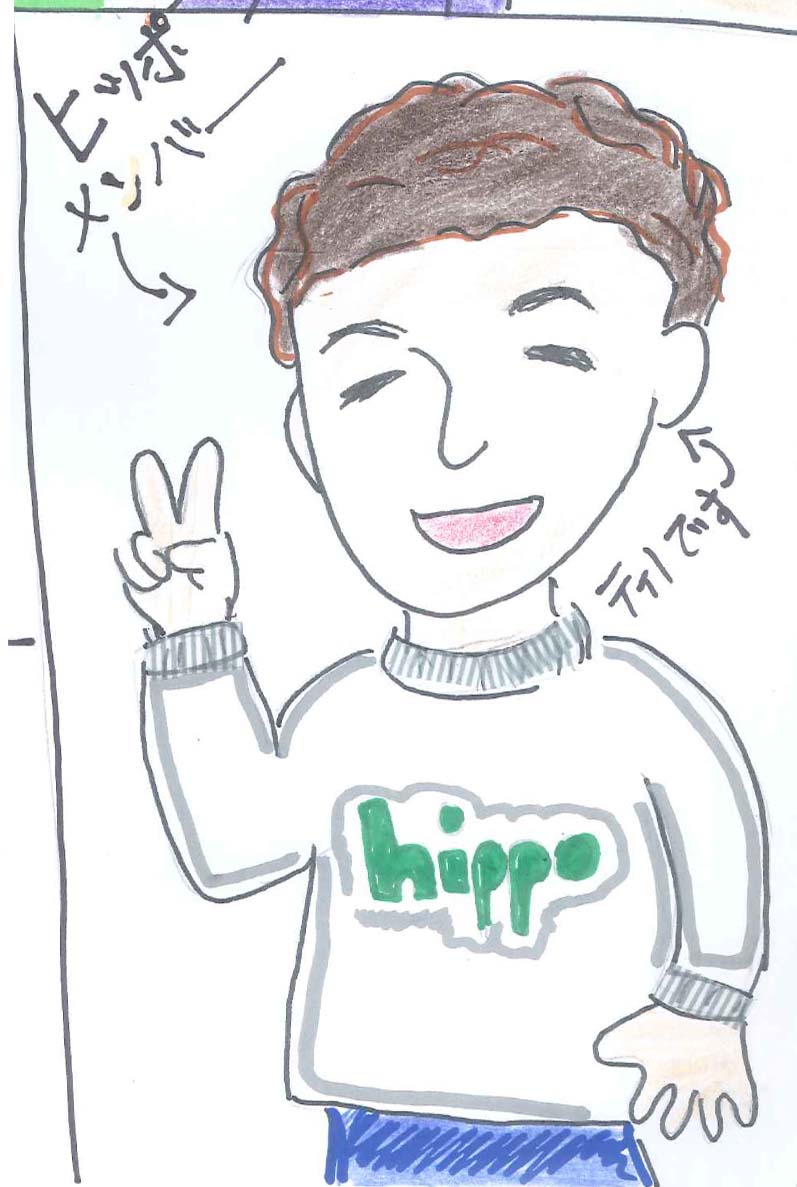
てぃの。

Tino.

Thursday, April 12, 2012

The Month of March & How to Count Rabbits in 日本語

Wow, it's already April, which means March came and went so quickly! In case anyone is wondering what kinds of things the interns have been up to, here is a copy of my monthly report (and a translation in English) with a brief overview of what I've been doing recently:
 

This month I've attended lots of Hippo events (workshops, group sharing sessions, international learning classes at elementary schools, orientation camps for future exchange students, etc.) At one of the workshops I was one of the main speakers and gave a 15 minute presentation about my experience traveling internationally and working with 4-H and LEX, all in Japanese! My host mom helped me a lot to prepare and practice beforehand, which made me feel a lot more confident :)

The photo is from one of the international learning classes I attended with a group of 3rd and 4th graders. It was a change from how the classes usually go, where we as the coordinators give presentations about different cultures and lead games with the kids. This time the students prepared
presentations on their own Japanese culture and taught us about things like Japanese food, geography, games, and school. I think it was really great! They were really cute too and gave me all kinds of little origami presents.

We also had the second yearlong student midterm meeting at the office, and I have started meeting with some of the students who will go abroad this coming year as yearlong exchange students to give them a chance to practice English. The formal English interviews are pretty nerve wracking, so this is another chance to practice English in a relaxed environment. A lot of them are pretty shy, so I'm trying to come up with new games or other things we can do to get everyone talking and not feeling nervous.

My host family is really great and a lot of fun and we talk all the time about all kinds of things, so my Japanese has been improving a lot! My host sister Kano-chan is 11 but a lot of the time she acts like my big sister because she looks out for me and shows me the correct way to do things, like when to bow or how to say something more correctly in Japanese; she's really cute, and it's actually really helpful! The other day she taught me all about an important part of Japanese culture: the Japanese boy band Arashi! Kano-chan loves them and they are really popular right now. I can now proudly say I know all the band members' names and favorite colors. You never know when this might be an important thing to know...

My favorite new thing I've learned in Japanese is how to count rabbits. In the Japanese language, there are different endings for counting depending on what kind of object you are referring to. For example if you are counting thin, long objects, flat objects, mechanical devices, large animals, small animals, mirrors, hanging scrolls, words, umbrellas, or houses, they will all have a different ending that marks the number.  Normally for small animals, the ending -piki is used but rabbits happen to have a differend ending -ha, which is the ending used for birds or things with wings, because apparently rabbit's ears are so big and floppy they are considered to be just like wings!!!

Mi papa de México en Japón!

This last week was exciting because I got to see Javier, my host dad from Mexico again! He's one of the coordinators of LEX México so he came to Tokyo last week for work and vacation, and it was really nice to see him!

Almost two years ago, I went to México as an LEX intern for 3 months, and stayed with Javier's family in Mexico City. It was a great experience, and one of the main reasons I decided to apply for the LEX internship in Japan. I did a lot of the same things as an intern in Mexico as I do here in the office like help check documents and work with the exchange groups, and of course had the opportunity to live and work in an environment where I was always surrounded by and communicating in Spanish, which allowed my abilities and confidence in the language to improve more than I had ever expected! Though my experiences as an LEX intern in Mexico and Japan have been different in some aspects, one of the things that has always been the same is the people. All the LEX members I have met in both Mexico and Japan have corazones grandes y abiertos. They are welcoming, open, caring, and fun. Thank you again to everyone from LEX Mexico for welcoming me and creating such a positive experience! And thank you to LEX Japan for making it possible to continue my connection with LEX and have a whole new experience here!


2012 with other Hippo members in Tokyo

2010 with my host family in Mexico City
I'm always amazed by how many connections exist and are strongly maintained across the world through LEX. I've gotten to see so many people in Japan who I've met before in Wisconsin or Mexico through the LEX/4-H exchanges and I'm always meeting new people who I find out are like brothers or sisters because we stayed with the same host families or have connections with the same people. 嬉しい!

Thursday, February 16, 2012

Writing in 日本語

Every month the Hippo interns and exchange students write a report sharing about their experiences that month with other Hippo members. This month I decided to challenge myself to write it all in Japanese. It took me two full days to complete, and I'm sure it's far from perfect, but I did it! And what's more, everyone could understand it. :)


A lot of the time I still feel really lost during conversations or presentations in Japanese and I feel like there is so much I can't understand or communicate, but when I look at what I'm able to write four months after arriving in Japan without every having studied the language at all, I realize that I have learned a lot! 

Being able to read and write in Japanese is like unlocking a secret code, which is pretty much how it feels like as I'm trying to figure out what different characters mean and how they go together. It also helps me to understand a lot about grammar and the way that sentences and words are put together, which helps me to be able to better understand and communicate in spoken Japanese as well. For example, the Japanese word "ee-tah" can have three different meanings based on the context. I learned one of them, "went", and always thought that when people said this in conversation they were saying "so and so went", but this same sound can also mean "was" or "were" (referring to people) and "said". When I realized that they are different words, which look different when written, and Sakkun explained to me, it made conversations make a lot more sense, since to have been somewhere, said something, and gone somewhere are very different things.

Being able to understand written symbols also helps to understand the makeup and meaning of words. Just like knowing Latin roots can sometimes help you be able to figure out the meaning of an unfamiliar word in English, being able to understand the kanji and hiragana of Japanese allows me to understand new words in Japanese. For example I learned that the word "otokonoko" means child, but it was really hard for me to remember how to say this, since I would get confused as to the order of the consonant/vowel pairs which all end in "o". "O-to-ko-no-ko" and "o-ko-no-to-ko" sounded the same to me. But when I realized that "otoko-no-ko", which actually means boy, is written as 男の子, it finally made sense to me. 男 means man and is pronounced "otoko". の, pronounced "no", is suffix which means belonging to, -ese, type. And 子 "ko" means child. So 男の子 means man type child. 女 is the kanji for woman, pronounced "onna". So can you guess how to say girl (those who don't already speak Japanese)? 女の子 "onna-no-ko", woman type child. Very good!

Stephanie (すーちゃん)

Wednesday, February 15, 2012

亲爱的Hippo的兄弟姐妹们!你们好吗?!

Hola todos!!!
 大家好!我是索宁:-)

在这里我献给大家拜个年!
祝大家2012年龙年大吉
 
一帆风顺、二龙腾飞、
三羊开泰、四季平安、
五福临门、六六大顺、
七星高照、八方来财、
九九同心、十全十美、
百事亨通、千事吉祥、
万事如意  亿心同福!

我现在搬到了新的接待家庭之中,有了新的妹妹和弟弟:)
每一天都十分的开心.在今年的2月份刚开始的时候,回到了我的老家长春,在这里见到了很多很多的朋友和亲戚。
请大家时刻关注这里的动态!!我爱你们!!

Tuesday, February 14, 2012

What's Your Blood Type?

Discovery of the day:

It turns out that having a 'type A personality' or 'type B personality' has an entirely different meaning in Japan than in the U.S.

The other day while having lunch with some co-workers in the office, the main topic of a half-hour long conversation was blood type. Specifically which people had which blood type. I understand enough Japanese to know that this is what was being discussed but not quite enough to understand everything that was being said, and definitely not enough to understand why this was so funny and amusing to everyone.

Someone asked me what my blood type was. "O negative," I replied, which was met with an animated mixed chorus of "Oooooooh," "Mmmmmm" and "Ahhhhh". Well, it is the universal donor type, I thought. I suppose that's relatively impressive? Then they asked what type my family members were. "Uhh...I have no idea." It's not like I've ever had to give one of them a blood transfusion. When asked what type most people in America are I had to reply again that I don't know that either and I'm pretty sure that the majority of people in America don't even know what their own blood type is.

Someone said that most Japanese people have type O, so I thought maybe this was so interesting to them because most people in Japan had the same blood type and it was strange if someone had a different type? Especially type B; that one seemed to get singled out the most. Maybe it's really rare in Japan? Maybe there is just nothing else to talk about?!

So after feeling pretty lost during the whole conversation I Google searched "blood type Japan", to see if there was a common blood type or something. And what I found out is that here and other parts of Asia blood type is thought to be an indicator of your personality. Kind of like astrology in the West, but according to what I read, perhaps even more prevalent.  There is even a Japanese word for harassment due to blood type: "buruhara"(short and Japanese-icized for blood harassment).

This explains so much!!

Here is a link to an interesting article from BBC that I read about it:
http://news.bbc.co.uk/2/hi/8646236.stm

This also explains why one day an option to add my blood type to my Facebook profile page mysteriously appeared.  I know they've been updating the format a lot recently, though this seemed like an unnecessary bit of personal medical information to be asking for. But after some comparative analysis I realized that the 'one day' it appeared, not coincidentally, happened to be the very day that I arrived in Japan.


Exhibit A: a Korean romantic comedy called "My Boyfriend is Type-B". Apparently Type B is the wild and irresponsible personality type. Can't say I'm surprised that this film never took off in the U.S. but now I'll have to see if I can find it here!


Saturday, January 28, 2012

Last blog

Hola todos! Soy Gori de hippo intern program´11
Creo que este blog es mi último blog, escribí sobre idioma. Así que lean por favor!

Mi español
Mi español es un gran regalo de ustedes. Bueno, ya Tino escribió algo de esto. Pero pensé mucho antes! jaja Bueno,  ¿por qué pienso así? Porque las palabras que adquirí aquí, tiene relación con ustedes o sea adquirí español por las personas, mis familias y mis amigos. Por ejemplo cuando escucho la palabra “agenda” me acuerdo de mi papá Javier porque me la enseñó en abril primer día de mi trabajo y no me ha olvidado, me acuerdo muchas palabras con recuerdos de ustedes. Yo pienso que eso es adquirir idioma de forma natural. El camino de adquirir idioma no es estudiar o leer libros. El camino de adquirir idioma es un regalo de las personas que te rodean.
Escribí las palabras aquí, desde abril hasta enero y cada una palabra tiene historia con mi familia o mi amigo.
El libro te enseña muchas cosas pero fácil de olvidar. ¿Por qué? Porque el idioma nació para comunicar con la persona, no para leer libros. Entonces no vas a olvidar si aprendes el idioma por persona.
A mí me tocó ver a varios estudiantes de YLP. Y por ejemplo mi hermanita Fernanda, hace mucho que no habla japonés en México pero en el WS, habló muy bonito pero muy bonito. Ella estaba poco nerviosa pero habló como cantando. Yo no voy a olvidar español porque eso es inolvidable, olvidar español significa olvidar ustedes hippo México. Yo nunca olvidaré mi familia, mis amigos y hippo México. Yo pienso que el idioma que has aprendido de forma natural nunca te va olvidar.
Así que yo pienso que hay muy muy fuerte relación entre el idioma y tu familia, tu amigo.

Hablar varios idiomas
Quiero comentar una cosa que cómo me siento ahora. El proceso de adquirir el idioma es muy interesante y está impresionante. Todavía no sabemos muchas cosas sobre eso, por eso muy interesante y me gusta mucho pensar y investigar eso. Mi experiencia de español también fue muy interesante porque realmente no me di cuenta ¿desde cuándo pude entender español? Siempre me estoy observando sobre el idioma. Porque….quiero saber cómo!! Ahora yo pienso que el proceso de adquirir el idioma es muy padre pero también no es una cosa especial o sea todos podemos hablar cualquier idioma si tienes medio ambiente. Y tenemos un medio ambiente multilingüe. Disfruta hablar, escuchar y comunicar en varios idiomas con tu familia y tus amigos que te rodean. Eso es único camino de adquirir idioma de forma natural y estamos haciendo eso, en club familiar hippo con amigos del todo mundo!  

Quiero ser una persona multilingüe.
¿Por qué? Porque me gusta conocer la gente y conocer la gente es divertida y puedes aprender nueva cosa. Y cada vez que conozco una persona, me siento feliz, pasé varias experiencias y conocí muchas personas que las quiero durante…21 años toda mi vida y especialmente estos 10meses. Si puedo conocer cualquier país, cualquier idioma y cualquier persona, será muy padre ¿verdad?
Una persona multilingüe, como tino dice “somos Hippo yin (yin significa persona)”, es mi meta de ahora. Y para ser Hippo yin, siempre mantengo corazón abierto para toda la persona!

Arigatou
Hippo cambió la vida de muchas personas. Bueno ellos la cambiaron por su mismo con apoyo de hippo. Yo también soy una persona que cambié mi vida con hippo. Gracias a hippo y Gracias a mi familia por apoyarme, ayudarme y permitirme convivir con ustedes. Y lo siento me cometí muchos errores, me equivoque muchas veces. Pero aprendí de errores. Sin ustedes no podía lograr mi sueño. Ya me voy a regresar a Japón pero somos una familia, una familia súper bonita. Siempre los quiero y algún día, espero que pronto nos veamos.

Siii! Nos podemos ver otra vez y más! Porque somos una familia grande!
Nunca olvidaré Ustedes hippopos y mi vida de México.

Yuki Aratani / 荒谷 友紀